We know exactly how frustrating it is to constantly add water to an older backyard pool.
Evaporation in the desert naturally hides the signs of structural damage. David Resurface was founded with a simple mission: to provide exceptional pool remodeling and resurfacing services that customers can truly rely on.
Our daily inspections show that a dropping waterline on a 15-year-old plaster pool is usually the first clue of a bigger issue. Diagnosing the root cause quickly saves you from massive utility bills when you ask, is my pool leaking phoenix? Let’s review the data, discuss the warning signs, and walk through a reliable pool leak self test.
Why This Matters in Phoenix
We see extreme evaporation mask severe structural leaks every single summer. A leak quietly destroys your yard and drains your wallet while blending in with normal water loss.
A standard 15,000-gallon pool in Maricopa County can easily lose 10 to 20 gallons of water per day just to the hot sun. Our team constantly reminds homeowners that this high baseline of up to 3 inches per week in July-August makes visual diagnosis difficult.
Left untreated, the escaping water heavily stresses the aging shotcrete shell. It can even undermine the surrounding landscaping and deck foundations in the worst case.
- We monitor three primary consequences of ignoring a dropping water line:
- Inflated monthly utility bills are the most immediate financial hit.
- Progressive soil erosion beneath concrete decking creates dangerous tripping hazards.
- Our experience shows that unbalanced water chemistry requires massive amounts of excess chemicals.
- Ignoring these symptoms always leads to more expensive restoration work down the road.
- Spotting the difference between evaporation and a broken pipe is your first line of defense.
The Bucket Test (DIY Leak Check)
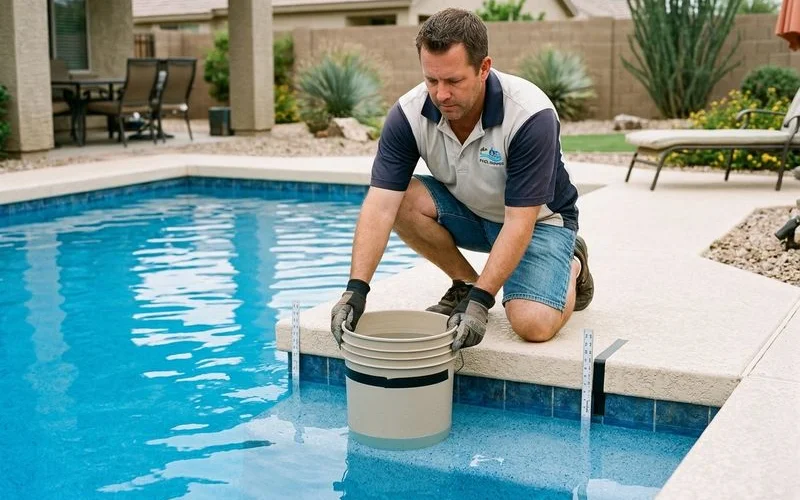
We recommend the classic bucket test as the absolute best way to isolate natural evaporation from a physical breach. This simple DIY diagnostic isolates evaporation from leaks, removing the guesswork from your dropping water line. The process requires nothing more than a standard 5-gallon bucket and a marker.
Our most critical piece of advice is to completely turn off your automatic water leveler before starting. An active auto-fill will continuously add water and completely ruin the 24-hour test results. The bucket test isolates evaporation from leaks by following these steps:
- We advise filling a bucket with pool water and placing it on the pool step.
- Turn off the automatic fill valve.
- Mark the water level inside the bucket.
- Our next step is marking the pool water level on the outside of the bucket.
- Wait exactly 24 hours with the pool at normal operation.
- Compare the two marks side-by-side.
Reading the result
We consider it evaporation only and no leak if both marks dropped the same amount.
A pool level that dropped more than the bucket level indicates a real leak. The gap between the drops tells you the exact leak rate.
Other Warning Signs
Our technicians look for several specific red flags when the bucket test confirms a problem. Beyond the bucket test, watch for these physical signs pool is leaking around your backyard.
A dropping water line is rarely the only symptom of a failing system.
Water loss beyond normal evaporation
We base our diagnosis on a consistent loss of more than 1 inch per day year-round. Phoenix evaporation benchmarks vary wildly depending on the month and the weather. High winds can easily triple these baseline figures during a summer storm.
Our seasonal benchmark for summer from May to September is 1/4 to 1/2 inch of daily loss. Winter months from November to February usually see only 1/8 to 1/4 inch of daily evaporation. Tracking these numbers for a few days gives you a clear baseline.
| Season | Average Daily Loss |
|---|---|
| Summer (May-Sep) | 1/4 to 1/2 inch |
| Winter (Nov-Feb) | 1/8 to 1/4 inch |
Wet spots around the pool perimeter
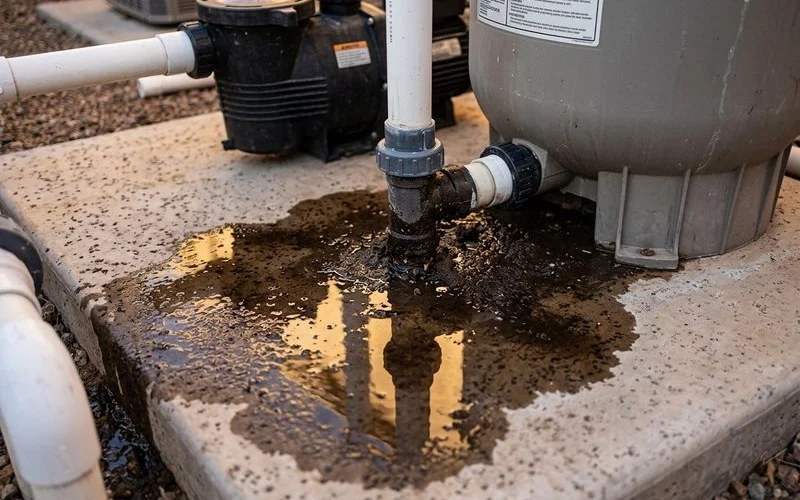
We often spot underground plumbing issues by simply walking the deck and looking for structural shifts. Soggy landscaping near the equipment pad or unusually healthy grass points straight to an underground pipe failure. These visual clues typically indicate a suction-side or return-line leak.
Our crews frequently see sunken concrete decking or excessive white calcium scale along the perimeter. Constant moisture slowly washes away the compacted dirt beneath the deck. Fixing this quickly prevents major structural settling.
Equipment cycling more than usual
We advise checking your digital pump display if you hear the motor cycling more frequently than it used to. An overworked pump means the system is losing its prime or struggling with internal water pressure.
Modern variable speed units from brands like Hayward or Pentair will frequently flash a “Prime Fail” error code. Our first troubleshooting step is inspecting the pump lid O-ring for tiny air gaps. A cracked O-ring pulls air directly into the vortex, starving the system of water.
This specific issue is often tied directly to suction-side plumbing leaks.
Visible cracks in the shell
We diagnose shell cracks as the most frequent culprit for major water loss in older properties. Hairline cracks do not always leak, but you must monitor them closely.
Cracks that have opened or that you can push a fingernail into can easily pass water. Our specialists pay special attention to gunite or shotcrete pools that have been baking in the sun for 10 to 15 years.
Ground settling and extreme temperature fluctuations eventually stress the rigid structure until it snaps. Pool shell cracks are the specific leaks we treat most often across the Valley.
Chlorine and chemistry that won’t hold
We track chemical balances closely because extreme fluctuations often reveal hidden drainage issues. A leaking pool is also losing chemically-treated water and replacing it with tap water.
Chlorine demand rises, alkalinity and hardness fluctuate, and nothing balances properly. Our favorite diagnostic trick is to measure your Cyanuric Acid levels. Cyanuric Acid protects your chlorine from the sun and it absolutely does not evaporate into the air.
A sudden plunge in this stabilizer guarantees that physical liquid is escaping the basin.
What To Do Next
We are ready to step in if your bucket test or other signs point toward a leak.
Call for an on-site assessment before the damage spreads to your home’s foundation. Professional diagnostics go far beyond visual inspections to pinpoint the exact source of the failure.
Our technicians use dye tests to see visible dye migrate toward underwater leak sources. Pressure tests confirm the integrity of your hidden plumbing lines quickly and accurately. You can protect your investment by acting quickly at the first sign of water loss.
We invite you to schedule Our pool crack repair and leak detection service for a complete resolution. This comprehensive visit covers diagnosis, injection, structural stapling, and long-term escalation guidance.
Read our injection vs stapling vs resurface guide to understand the different repair methods.