Working with aging concrete pools every day reveals a clear pattern. Homeowners usually notice the rough texture first, but the real concern is the underlying surface integrity.
In a hot climate, small chalky spots mean the protective barrier is failing. We see this constantly on 15-year-old structures across the valley.
The decision to resurface is critical to prevent structural water damage.
So, let’s break down the realistic pool plaster cost arizona homeowners face this year, the hidden variables, and how to spot a questionable estimate.
The Arizona Plaster Range
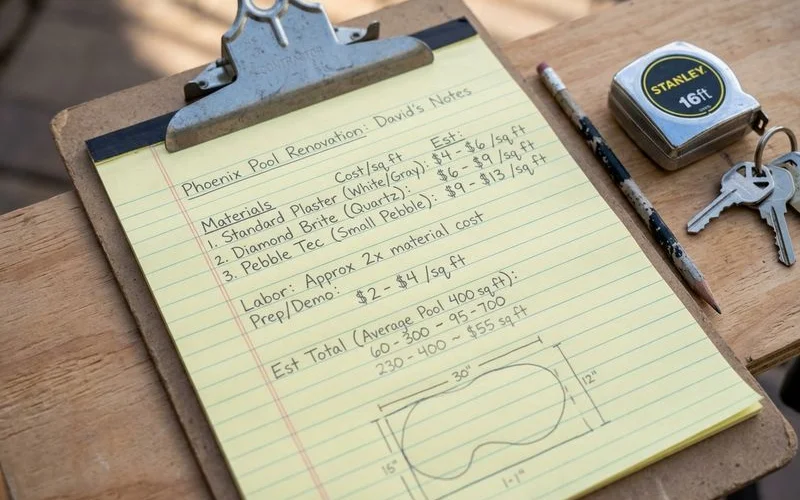
Pool plaster in Phoenix runs $6 to $9 per square foot installed. On an average 500-square-foot backyard pool, that translates to $3,500 to $6,500 completely finished.
Our local supplier data from early 2026 confirms these figures remain steady. A standard replaster pool price phoenix contractors quote will cover materials, labor, and basic startup chemicals.
Plaster remains the most affordable interior finish. It runs roughly 40% to 60% less than premium finishes for an equivalent pool, matching the different lifespan profiles.
You can review our detailed plaster vs aggregate comparison for the full cost-per-year breakdown.
5 Cost Drivers
1. Pool size
Costs scale directly with the square footage of your swimming area. The pool plaster price per sq ft will be the baseline for any quote.
Larger pools sometimes see marginal per-square-foot discounts. Fixed setup expenses like the initial drain and heavy equipment staging are spread over a much larger surface.
We often remind clients that certain features require more hand-troweling labor, which slightly reduces those volume discounts:
- Extensive seating benches
- Complex tanning ledges
- Sharp geometric corners
- Attached custom spas
2. Prep scope
A bond-coat over sound plaster is the cheapest option, running $1 to $2 per square foot. Contractors typically use a commercial bonding agent like SGM One-Step Bond-Kote.
This product requires a precise 80-mil application thickness to ensure the new material adheres correctly to the old surface. A full chip-out becomes necessary when the existing material is actively delaminating, adding $3 to $5 per square foot.
Our technicians find that older concrete shells with multiple past resurfacing cycles almost always require a full chip-out. Stripping the shell down to the original gunite ensures the new application bonds flawlessly.
3. Hard-water prep
Visible calcium scaling adds $500 to $1,500 in prep labor for hydroblasting or extended acid-washing. Skipping this critical step is the absolute fastest way to guarantee a failed project.
Tap water in our region regularly measures between 250 and 400 parts per million (ppm) of calcium hardness. Evaporation drives these numbers past 1,000 ppm over a decade, causing several persistent issues:
- Heavy calcium silicate crusts on walls
- Clogged filtration equipment
- Poor adhesion for new plaster materials
We use concentrated muriatic acid treatments to strip away this stubborn mineral buildup. A clean, porous surface is mandatory before any fresh material can properly adhere.
4. Tile scope
Waterline tile replacement operates as a completely separate line item. Upgrading to popular glass or ceramic options from brands like National Pool Tile runs $75 to $200 per linear foot.
Most standard backyards feature 80 to 120 linear feet of waterline perimeter. Combining this tile work with your resurfacing saves one entire drain cycle.
Our project managers highly recommend doing both jobs simultaneously. It minimizes backyard disruption and prevents you from paying for a second heavy equipment mobilization next year.
5. Mid-project add-ons
Structural cracks discovered during the draining phase get priced separately. These repairs range from $300 to $1,500 depending on the required severity and stabilization method.
We utilize engineered Torque Lock structural staples rather than cheap epoxy injections. These patented metal staples provide up to 5,000 pounds of controlled compression, physically preventing the concrete from shifting again.
Common structural add-ons found on pools older than 15 years include:
- Rebar exposure patching ($200 to $600)
- Main drain replacement to meet current safety codes
- Return line fitting upgrades
Comparison to Aggregate
Standard white plaster wins on upfront cost, but aggregate finishes win on long-term value and lifespan. The material you choose drastically impacts the daily foot-feel and the final cost-per-year of the project.
We always encourage clients to look beyond the initial price tag. Basic finishes offer a smooth texture, while aggregate blends provide enhanced durability and slip resistance.
| Finish | Avg 500 sq ft pool | Lifespan (AZ) | Cost/year |
|---|---|---|---|
| Plaster | $4,500 | 10 years | $450 |
| Diamond Brite | $6,000 | 12 years | $500 |
| Pebble Tec | $7,500 | 17 years | $441 |
The lower initial investment for standard plaster makes sense if you plan to move within a few years. Aggregate surfaces offer superior long-hold economics.
A premium Pebble Tec interior often includes a 15-year warranty, compared to the standard 1-to-5-year coverage offered on basic mixtures.
When the Cheapest Quote is a Red Flag
Bids dramatically below the standard $6 per square foot rate usually mean the contractor is skipping critical preparation steps. Shortcuts like ignoring severe hard-water scale or working without a proper license will cost you significantly more in future repairs.
Under-$5/sq ft plaster bids, walk carefully
Bids dramatically below $6/sq ft for Phoenix plaster typically skip something: no chip-out when chip-out is required, unlicensed contractor (no ROC), no permit, or no hard-water prep. All four cost more in the long run than the money saved upfront.
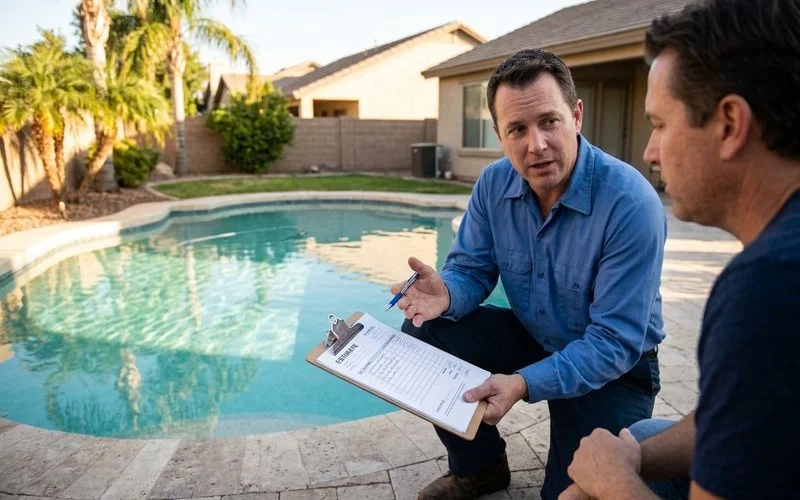
Always ask a contractor to walk through their scope of work line-by-line. A legitimate estimate must cover the drain-and-refill process, surface prep, application, the acid-wash startup, and first-week chemistry balancing.
We provide full transparency on every single project. Request a written estimate from us and our team will clearly show each expense line separately.
Understanding the true pool plaster cost arizona properties require is the best way to protect your investment.
Review your current surface for chalking or rough spots this week, and contact a professional when you are ready to explore your options.