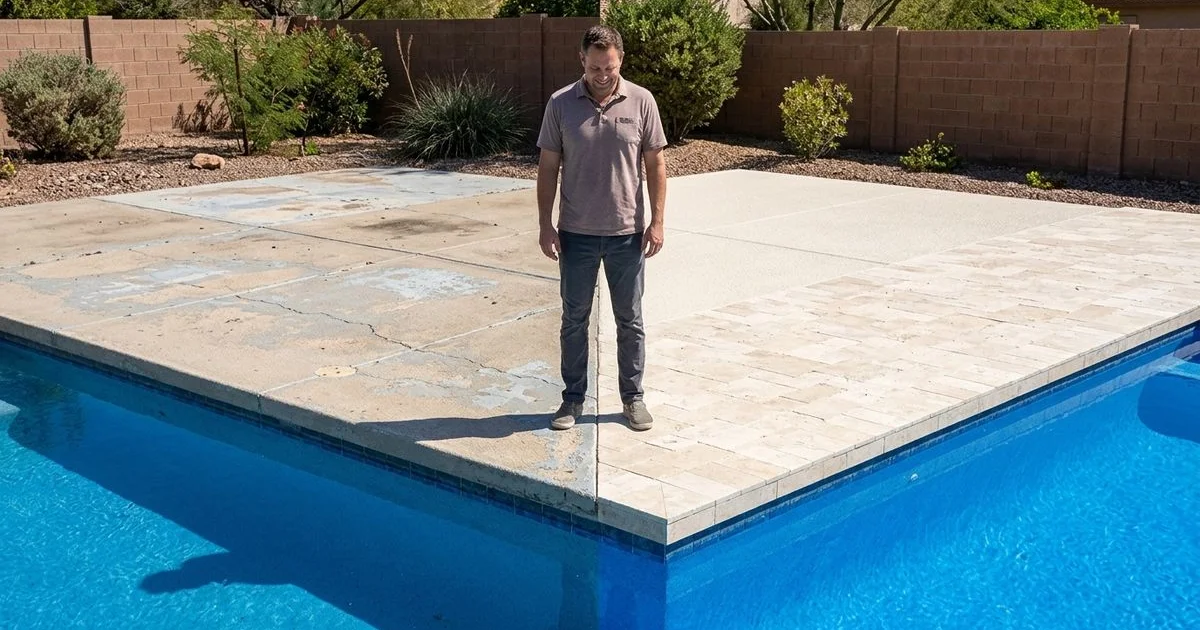
We see dozens of pools every month hitting that 15-year mark with tired plaster and cracking concrete. At David Resurface, our foundational mission is to provide exceptional pool remodeling services that homeowners can completely rely on during these major upgrades. The defining conversation for these older backyards is almost always the classic pavers vs cool deck debate.
You know how fast a worn-out, blistering hot pool surround ruins the entire backyard experience.
Our team approaches this choice by looking at actual surface temperatures and long-term repair costs. Let’s break down the exact performance data for both materials in the US desert climate and outline a clear plan for your upgrade.
The Fundamental Trade-Off
Choosing between travertine vs cool deck means weighing a premium 25-year stone against an affordable 5-year acrylic coating. This primary choice dictates your entire project timeline and renovation budget.
We always start by comparing the raw data on heat resistance and lifespan. Cool Deck blends acrylic polymers with concrete to create tiny air pockets. Those tiny gaps physically block heat transfer from the sun.
The resulting surface stays 15 to 25 degrees cooler than standard bare concrete. Our recent 2026 pricing data shows cool deck resurfacing runs about $3 to $6 per square foot in the US.
Travertine pavers demand a higher initial investment of $11 to $16 per square foot. The natural stone repays that cost with a lifespan easily exceeding 25 years. This comparison table outlines the most critical differences for a typical 500-square-foot residential pool deck.
| Factor | Travertine Pavers | Cool Deck |
|---|---|---|
| Upfront cost (500 sq ft) | $5,500-$8,000 | $1,500-$3,000 |
| US desert lifespan | 25+ years | 5-10 years |
| Peak heat (vs concrete) | 5-10°F cooler | 15-25°F cooler |
| Individual repair | Replace single paver | Full surface overlay |
| Design flexibility | High (French pattern, mix) | Color and texture only |
| Wet traction rating | 0.60 - 0.70 DCOF | 0.65 - 0.75 COF |
| Installation time | 5-7 days | 2-4 days |
When Pavers Win
Travertine pavers win decisively for homeowners planning to stay in their house for more than a decade. The initial premium translates into decades of durability and minimal repair headaches.
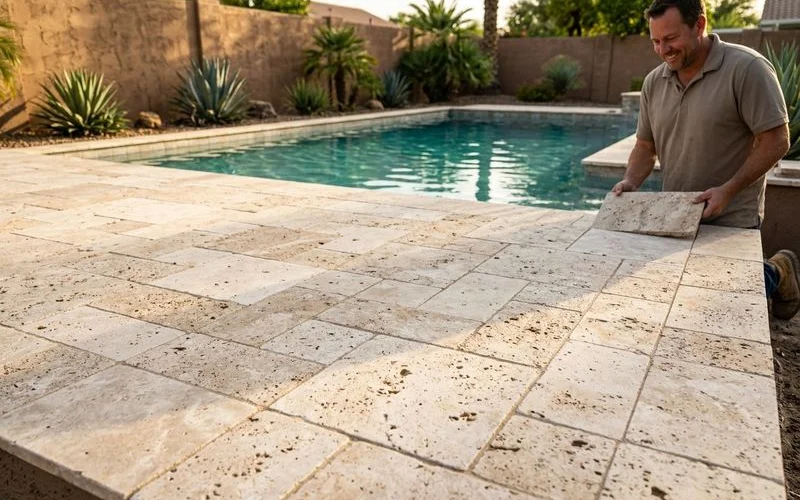
We highly recommend sourcing Turkish travertine instead of Mexican varieties for older pools. Turkish stone features a denser structure that actively resists damage from harsh pool chemicals and saltwater systems.
These premium stones stay surprisingly comfortable in direct sunlight. A high-quality cream travertine rarely exceeds 110 degrees Fahrenheit during a blistering July afternoon.
Here is a breakdown of the specific scenarios where pavers make the most sense:
- Long-hold homes: A 25-year lifespan spreads out the upfront cost beautifully over time.
- Underground plumbing access: Individual pavers can be lifted easily for pipe repairs without destroying the deck.
- Heavy kid-traffic pools: A high dynamic coefficient of friction rating of 0.60 to 0.70 prevents dangerous slips.
- Design-driven projects: French patterns and premium coping blend perfectly with high-end luxury aesthetics.
Our installation crews seal these stones right after laying them to block sunscreen and leaf stains. That routine sealing costs roughly $1.50 to $3.25 per square foot every two years.
For more on how travertine handles Phoenix heat specifically, see our travertine heat guide.
When Cool Deck Wins
Cool Deck wins when you need a fast, budget-friendly surface refresh that maximizes heat deflection. This acrylic coating provides the absolute best temperature drop per dollar spent.
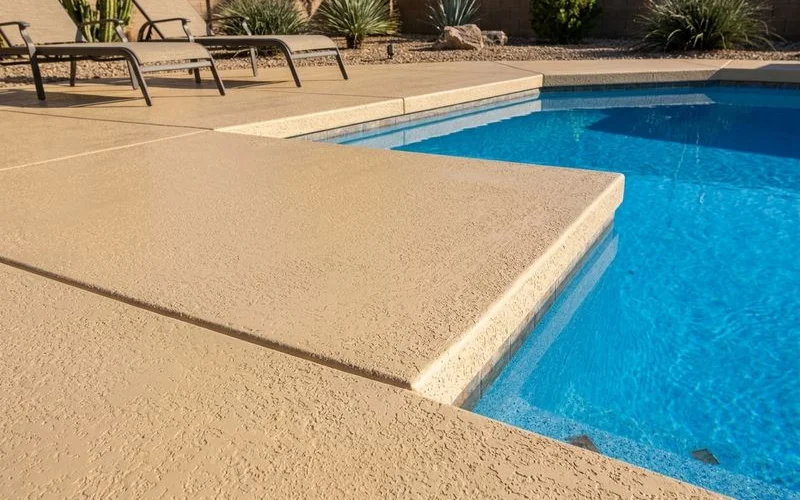
We routinely apply this coating over older concrete slabs that remain structurally sound but look terrible. The signature lace texture provides a wet coefficient of friction rating of up to 0.75 for outstanding grip.
This acrylic blend naturally limits heat absorption far better than bare cement. Consider a Cool Deck overlay if you fit into any of these categories:
- Budget refreshes: It delivers top-tier heat performance at just $3 to $6 per square foot.
- Short-hold homes: A 5 to 10-year lifespan is perfect if you plan to sell the house soon.
- Full-sun west-facing decks: The engineered air pockets block extreme afternoon UV rays effectively.
- Sound but worn concrete: The overlay process rescues an aging patio at a fraction of a full tear-out cost.
Our project managers advise customers that this coating will eventually show its age through fading. The extreme desert UV exposure breaks down the color pigments over a span of five to ten years.
Routine cleaning helps stretch that lifespan before a fresh overlay becomes necessary.
The Per-Year Math
The financial choice between these materials requires looking at the total cost of ownership over a 15-year timeline. A cheap upfront price often hides a much higher replacement cost down the road.
We calculate this by dividing the installation price by the expected lifespan of the material. A typical 500-square-foot paver deck at $6,500 spread over 25 years costs just $260 annually.
Our team compares that to a $2,500 Cool Deck installation that requires replacing every 8 years. That coating scenario averages out to $312 per year in ongoing maintenance and replacement cycles.
The Long-Term Return on Investment
On a straight cost-per-year basis, natural stone actually comes out ahead over a long hold period. You just have to retain ownership of the property long enough to realize that return on investment.
A premature property sale means you absorb the premium cost without getting the decades of free usage.
The 15-year breakeven
For a typical US residential backyard, pavers become cheaper than Cool Deck on a total-cost basis around year 15. Before that point, the lower upfront cost of an acrylic coating wins. After year 15, the natural stone option wins outright.
The Hybrid Option
A hybrid installation blends both materials to balance luxury aesthetics with a practical budget. This strategy places premium stone where it matters most and uses affordable coatings everywhere else.
We design many luxury backyards using Turkish travertine on the immediate perimeter coping. This puts the durable stone right at the water line where daily foot traffic and splashing occur.
Strategic Budget Allocation
The broad outer sections of the deck then receive the acrylic Cool Deck coating. This layout typically reduces the total project invoice by 30 to 40 percent compared to a pure paver job.
Our clients get the beautiful high-end look near the house and the budget-friendly heat relief near the fence. It represents the smartest compromise for massive residential properties with sprawling concrete footprints.
Ready to decide?
A quick consultation helps clarify which material fits your specific layout.
Our travertine paver service and Cool Deck service pages walk through each approach’s process and pricing in detail.